Journal Optimization Strategies in Event Sourcing DB Architecture
Intro
I currently work with an Event Sourcing (ES) architecture. One of the most interesting parts of ES is its database usage patterns. I always watch closely how client requests create load on our database. In this post, I want to share an interesting DB load problem I faced and how I solved it. First, let’s quickly go over what Event Sourcing is.
What Is Event Sourcing?
Event Sourcing is an architectural pattern. It stores all changes to an application’s state as a sequence of events. The traditional way is to save just the current state. Instead, ES carefully records every event that led to that state, in the order they happened.
Typically, you only need two database tables to store an entity’s state:
- Journal: This table records all events in the order they happen. It is just like a detailed accounting ledger.
CREATE TABLE IF NOT EXISTS journals (
  -- ID of the entity the event belongs to (e.g., user_id, guild_id)
  persistence_id VARCHAR(255) NOT NULL,
  -- Event number (starts from 1)
  sequence_number INT8 NOT NULL,
  -- Event type (determines which object to deserialize into)
  manifest VARCHAR(255) NOT NULL,
  -- The event binary, serialized (e.g., protobuf)
  journal BYTEA NOT NULL,
  -- When the event was created
  created_at TIMESTAMP NOT NULL,

  PRIMARY KEY(persistence_id, sequence_number)
);- Snapshot: This table stores the application state at a specific point in time. Replaying all events from the journal to get the current state can be slow. So we save snapshots regularly to make recovery faster.
CREATE TABLE IF NOT EXISTS snapshots (
  -- ID of the entity (e.g., user_id, guild_id)
  persistence_id VARCHAR(255) NOT NULL,
  -- The last event number included in this snapshot.
  -- (e.g., 100 means this state reflects events up to #100)
  sequence_number INT8 NOT NULL,
  -- Snapshot type (for deserialization)
  manifest VARCHAR(255) NOT NULL,
  -- The snapshot binary, serialized (e.g., protobuf)
  snapshot BYTEA NOT NULL,
  -- When the snapshot was created
  created_at TIMESTAMP NOT NULL,

  PRIMARY KEY(persistence_id, sequence_number)
);
As we develop new features, we often define new event types. However, we don’t need to change the journals or snapshots DB schema each time. This is a huge benefit of Event Sourcing. The database usage pattern is very simple, so we don’t have to worry about schema migrations for new features.
“Update” requests work by publishing new events. “Get” requests work by loading the latest snapshot first. Then they replay any new events from the journal on top of it.
Let’s use a kingdom-building game as an example. When a user requests to ‘establish a building,’ two events are generated:
BuildingEstablishedRewardReceived
The game server gets the final user state by loading a snapshot and replaying these two new events.
Repeated Journaling Problem
The establishBuilding feature already existed. It included various checks, like building location validation and user level checks, etc.
Then, we got a new requirement: a feature to build multiple buildings at once. Before, the user had to click the button 100 times to build 100 buildings. With this feature, the user could just click a ‘Build All’ button once. This would be much more convenient.
How should we implement this? The existing establishBuilding function was stable. It had been through code reviews and QA, and it was proven in our live environment. We wanted to reuse this stable logic. So we considered calling it repeatedly, like establishBuilding.replicateA(n).
We actually implemented it this way, and it worked fine on live. However, our metrics showed something suspicious. You’ve probably already guessed the problem. We were tracking a metric called lifted-events-count. It counts the events generated by a single RPC request.
// Part of the event persistence logic (conceptual code)
val eventsToPersist: List[Event] = ...
// add tracing
tracing.setAttribute("lifted-events-count", eventsToPersist.length)
// persists to DB
persistentEntityRepository.addEvents(eventsToPersist)
And we discovered that too many events were being saved in a single transaction.
// Query in Datadog
env:prod-live-* and @lifted-events-count:>=80
If this query caught a request, it meant a single RPC request was creating 80 or more events. We confirmed that the EstablishBuilding RPC was triggering this. Then we checked the DB state at that timestamp.
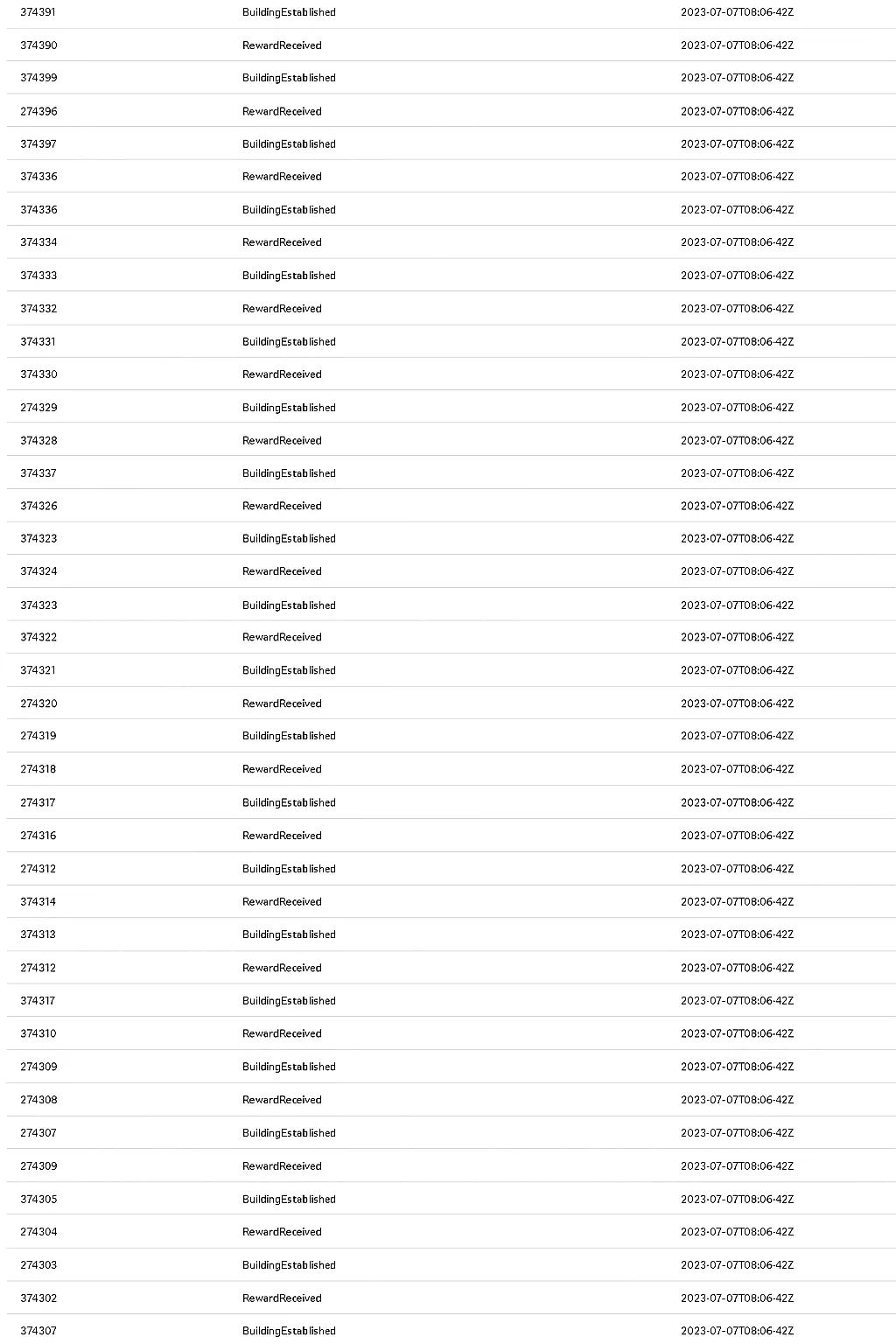
I found a huge number of repeated BuildingEstablished and RewardReceived pairs with same timestamp.
Two Approaches for DB Journaling Optimization
To fix this, I needed to add some journaling optimization logic. The question was, where should I put this logic?
- One option is in a post-process layer. This layer looks at all events after they are generated and merges them.
- The other is in the domain logic layer. This layer creates optimized (merged) events from the start.
Let’s look at both.
Approach 1: Event Aggregation in a Post-Processing Layer
The first approach is to create an optimization process in a “post-process” layer. This layer can see all the events emitted by the domain logic. It looks for specific patterns and merges them.
In our example (building 100 buildings), this layer would see 200 events (100 pairs of BuildingEstablished -> RewardReceived). It would then optimize them into just two aggregated events: BuildingsEstablished(buildings) and RewardsReceived(rewards).
To do this, we’d need an EventOptimizer. It would recognize the BuildingEstablished -> RewardReceived pattern and convert it.
/**
 * Concept: Pattern-based Event Aggregator
 * Merges consecutive (BuildingEstablished -> RewardReceived) pairs
 * into aggregated events (BuildingsEstablished, RewardsReceived).
 */
def optimize(events: List[Event]): List[Event] = {
  // Tail-recursive helper to maintain state while traversing
  def loop(remaining: List[Event], buildings: List[Building], rewards: List[Reward]): List[Event] =
    (remaining, buildings, rewards) match {

      // Case 1: Matching the Pattern (Building -> Reward)
      case (BuildingEstablished(b) :: RewardReceived(r) :: tail, bs, rs) =>
        loop(tail, bs :+ b, rs :+ r)

      // Case 2: Pattern ends or non-matching event found
      case (other :: tail, bs, rs) =>
        flush(bs, rs) ++ (other :: loop(tail, Nil, Nil))

      // Case 3: Reached the end of the list
      case (Nil, bs, rs) =>
        flush(bs, rs)
    }

  // Helper to convert collected items into aggregated events
  def flush(bs: List[Building], rs: List[Reward]): List[Event] =
    List(Option.when(bs.nonEmpty)(BuildingsEstablished(bs)),
         Option.when(rs.nonEmpty)(RewardsReceived(rs))).flatten

  loop(events, Nil, Nil)
}
Pros
The big advantage here is that the domain logic stays clean. The domain can still express the business logic as establishBuilding.replicateA(n). Developers can focus on the core domain logic without worrying about optimization details.
Cons
However, there are serious downsides. A new feature in the logic layer may break this pattern. If that happens, the post-process optimizer might break too.
For example, imagine a new requirement where building costs a resource (Paid). The journal pattern would become: BuildingEstablished -> Paid -> RewardReceived -> BuildingEstablished -> Paid -> RewardReceived -> … The old optimizer was designed to find BuildingEstablished -> RewardReceived pairs. It would stop working.
Another risk is that post-processing can damage the integrity of the events. This integrity is a core strength of Event Sourcing. Event optimization can cause the original result to be lost.
For example, let’s say we aggregate the BuildingEstablished -> Paid -> RewardReceived -> … pattern. We turn it into three aggregated events: BuildingsEstablished, Paids, and RewardsReceived. Suppose the original Paid event decreased itemId1 by 1. Then the aggregated Paids event might decrease itemId1 by n all at once.
The result of (pay -1, get reward +1) repeated n times can be different from the result of (pay -n, get reward +n) done once. The second case might fail if the item count drops below zero. Or the item may have a .max(0) control to prevent it from going negative. Then it wouldn’t fail, but the final state could be different. In other words, event aggregation can change the flow of state changes in ways that are hard to notice. It can also cause unexpected side effects.
Because of this, the post-process approach is more suitable for simple, repetitive patterns of a single event type, (e.g., RewardReceived -> RewardReceived -> …). It’s generally not recommended for complex patterns with multiple event types that are deeply connected to changing domain logic.
Approach 2: Emitting Merged Events from the Domain Logic Layer
The best solution for our specific problem was to emit aggregated events directly from the domain logic layer. This is the one we chose in the end. It optimizes events at their source. We define new aggregated events like BuildingsEstablished and RewardsReceived. We emit them from within the domain logic itself.
Let’s go back to our game example, with 100 buildings built at the same time. We no longer emit 100 pairs of BuildingEstablished and RewardReceived. Instead, we emit just two aggregated events. A single BuildingsEstablished event contains all built buildings. A single RewardsReceived event contains all earned rewards.
// Emits 2 * n events (BuildingEstablished, RewardReceived)
def establishBuilding(building: Building): ZPure[Event, GameState, GameState, Any, Failure, Unit] =
  for {
    _ <- ZPure.validate(checkLocation(building))
    _ <- ZPure.log(BuildingEstablished(building)) // Single log
    s <- ZPure.get[GameState]
    _ <- ZPure.log(RewardReceived(getRewards(s, building))) // Single log
  } yield ()

def buildAll(buildings: List[Building]) = ZPure.foreach(buildings)(establishBuilding)
⬇️
// Emits exactly 2 aggregated events
def establishBuildings(buildings: List[Building]): ZPure[Event, GameState, GameState, Any, Failure, Unit] =
  for {
    _ <- ZPure.validate(checkAllLocations(buildings))

    // Process all logic first without logging
    results <- ZPure.traverse(buildings) { b =>
      ZPure.get[GameState].map(s => (b, getRewards(s, b)))
    }

    // Flush as aggregated data
    _ <- ZPure.log(BuildingsEstablished(results.map(_._1)))
    _ <- ZPure.log(RewardsReceived(results.flatMap(_._2)))
  } yield ()
Pros
This approach greatly reduces the DB journal load. It emits only two events (BuildingsEstablished(...) and RewardsReceived(...)) instead of hundreds. Also, the optimizer is unlikely to damage the domain logic. This is because the optimizer itself is part of the domain logic. So when new features are introduced, it is unlikely that one will be considered without the other.
Cons
However, this method makes the domain logic a bit messier and harder to implement. It must be written carefully. For all scenarios, the state change must be logically identical to calling buildings.traverse(establishBuilding). It is definitely possible to make mistakes, and using buildings.traverse(establishBuilding) feels cleaner and more intuitive. But to get better performance, I often find this level of added complexity in the domain logic acceptable.
Why Event Sourcing Makes This Optimization Possible
Before we finish, I want to look again at why Event Sourcing makes these kinds of optimizations possible. It’s because its DB usage pattern is so simple.
First, the schema is simple. In a traditional SQL (relational database) approach, we would need a buildings table to store building info. We would also need a rewards table (or update a user_items table). To optimize a “build multiple” feature, we’d have to think about “bulk inserts” (INSERT INTO buildings ... VALUES (...), (...), ...) or “bulk updates” for the user_items table. This means the application logic is tightly coupled with the DB schema. In Event Sourcing, the schema is just the journals table. So we can focus only on the logical optimization of “combining events” at the application level.
Second, emitting events is separate from saving (persisting) them. In ES, a DB access doesn’t happen at the moment an event is “emitted.” The event is just an “Effect” that has been declared. In our project, the act of emitting an event and the act of persisting it to the database are naturally separated. This lets us delay the actual process of saving the event to the DB. This “lazy space” gives us room to consider various optimization strategies easily. Because these two actions are separate, we have the flexibility to collect and optimize events before they are finally written to the DB.
Conclusion
The benefit of the first post-process approach is that it keeps the domain logic clean. Developers do not have to worry all the time about the number of events emitted from complex domain logic. This method works well for simple, repetitive patterns, like RewardReceived appearing in many parts of the logic. However, you must remember that it has the risk of damaging the integrity of the event history.
In contrast, the second approach is emitting merged events from the logic layer, so it optimizes at the source. It provides a more fundamental and stable solution. The trade-off is that the domain logic becomes more complex. This is because it has to include event aggregation logic.
In our project, we see both approaches as valid. We use them where they fit, based on their pros and cons.